
You can tell an AI reply from a human reply in about three words. So can the X algorithm.
Generic AI output, the kind with perfectly balanced sentences and words like "fantastic insight", performs worse than average replies. It is not just that readers ignore it. Low-engagement replies signal the algorithm against your account. But Grok, used correctly with strict constraints, is a different tool entirely.
The problem is not AI itself. The problem is unconstrained AI. Without strict instructions, Grok defaults to a cheerleading tone, covers every angle of the post, and writes something that sounds like a polished press release.
That kills engagement. A reply that tries to address everything says nothing specific. Readers scroll past it. The original poster does not respond. The algorithm does not push it further.
The second problem is that even a well-crafted AI reply goes nowhere if it lands in the wrong thread.
Most replies get no impressions because of placement, not quality. A reply posted two hours after a post peaked reaches almost no one regardless of how it was written. AI cannot fix a placement problem. The sequence matters: find the right post first, then use Grok to write the reply. In the wrong order, you are just automating mediocrity.
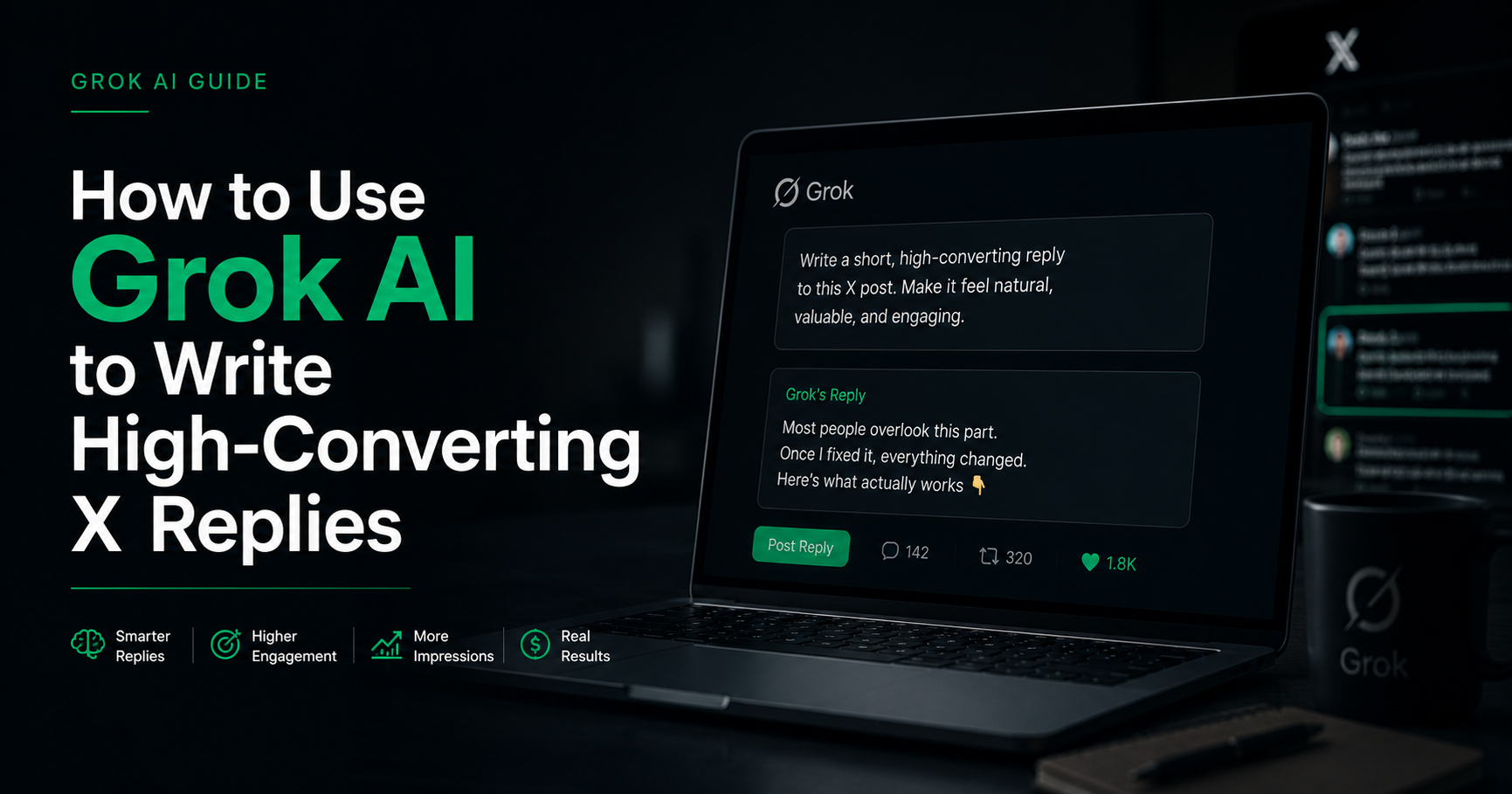
Most people paste a post into Grok and say "write a reply." That produces the generic output that gets ignored. The fix is a prompt that forces constraints before Grok writes a single word, something that strips out the cheerleading, limits the length, and demands a real question that keeps the conversation going.
Grok's default output is designed to be helpful and comprehensive. For X replies, helpful and comprehensive is exactly wrong. You need something specific, direct, and short enough to read on a phone mid-scroll.
When you combine posts that are still in their engagement window with a constrained Grok prompt, the output changes. The reply is direct. It takes one clear angle. It ends with a real question that generates a response.
Here is the prompt:
Write a direct, human-to-human reply in 2-3 sentences.
Be brutally honest. Avoid em dashes. Avoid post commentary.
Avoid post-reflection. Avoid cheering from the sidelines.
Avoid answering all post details.
Avoid words like game changer, fluff, or friction, moves the needle.
Double-check and verify data and information before providing an answer.
Have a clear question in between to keep the engagement (a real one and not reflective).
The reply must focus on one clear angle of the post.
Before providing a reply, review the answer to meet all instructions above.
ReplyHunter finds the post worth replying to. Grok with this prompt writes the reply. The combination is what makes it work.
Stop writing generic replies. Start hunting.
Find the right post first. Then let Grok write a reply that actually gets seen.
Get Early Access (Free)Frequently Asked Questions
Can you use Grok AI to write replies on X?
Yes, but the quality of the output depends almost entirely on the prompt. Without tight constraints, Grok defaults to a comprehensive, cheerleading tone that reads as AI-generated to both readers and the algorithm. With strict constraints, limiting length, banning filler phrases, requiring a single angle and a genuine question,Grok produces replies that feel human and generate real engagement.
Why do AI replies perform poorly on X?
AI replies without strict prompts tend to be balanced, thorough, and generic, exactly the opposite of what drives engagement on X. The X algorithm rewards replies that generate conversation, profile clicks, and dwell time. A reply that tries to cover every angle of a post and ends with "great insight!" produces none of those signals. The algorithm treats low-engagement replies as a negative signal against the account that posted them.
What makes a good Grok prompt for writing X replies?
An effective prompt bans generic phrases, limits the reply to 2 to 3 sentences, requires focus on a single angle of the post, and mandates a genuine question at the end. It should also require Grok to review its own output before delivering it. These constraints force Grok away from its default comprehensive tone and toward something specific enough to generate a response from the original poster.
How do you combine AI with a reply strategy on X?
The correct sequence is: find a post that is still in its engagement window (the first 15 to 30 minutes after going live), then use Grok with a constrained prompt to write the reply. Reversing the order, writing the reply first and then looking for a post to put it on, produces effort that goes into threads that have already peaked. Placement determines whether the reply gets seen. The prompt determines whether it generates engagement once seen.
How do you get Grok to reply to a post on X?
Reply to any post and tag @grok with your question, for example "@grok is this claim accurate?". Grok answers publicly in the thread. This is different from using Grok to write your reply: when you tag @grok, the answer belongs to Grok's account, not yours. It can be useful for fact-checking a thread, but it builds no engagement for you, since the impressions and follow-through go to Grok's response rather than your own words.
Is tagging @grok a good reply strategy?
Not as a growth tactic. A @grok tag adds a question to the thread but no perspective of your own, so readers have no reason to click your profile. The approach that grows an account is the reverse: use Grok privately with a constrained prompt to draft a reply in your own voice, post it under your own name, and keep the engagement it earns. Tag @grok when you genuinely want a fact checked in public, not as a substitute for writing a reply.
Does using AI to write replies violate X's rules?
X's rules prohibit spam and inauthentic behavior, not AI-assisted writing. Using Grok to draft a reply that you review, edit, and post under your own name is no different from using any other writing tool. The distinction X draws is between automated mass-posting without human involvement and AI-assisted writing that still involves human judgment and editing. The prompt approach above is firmly in the second category.