
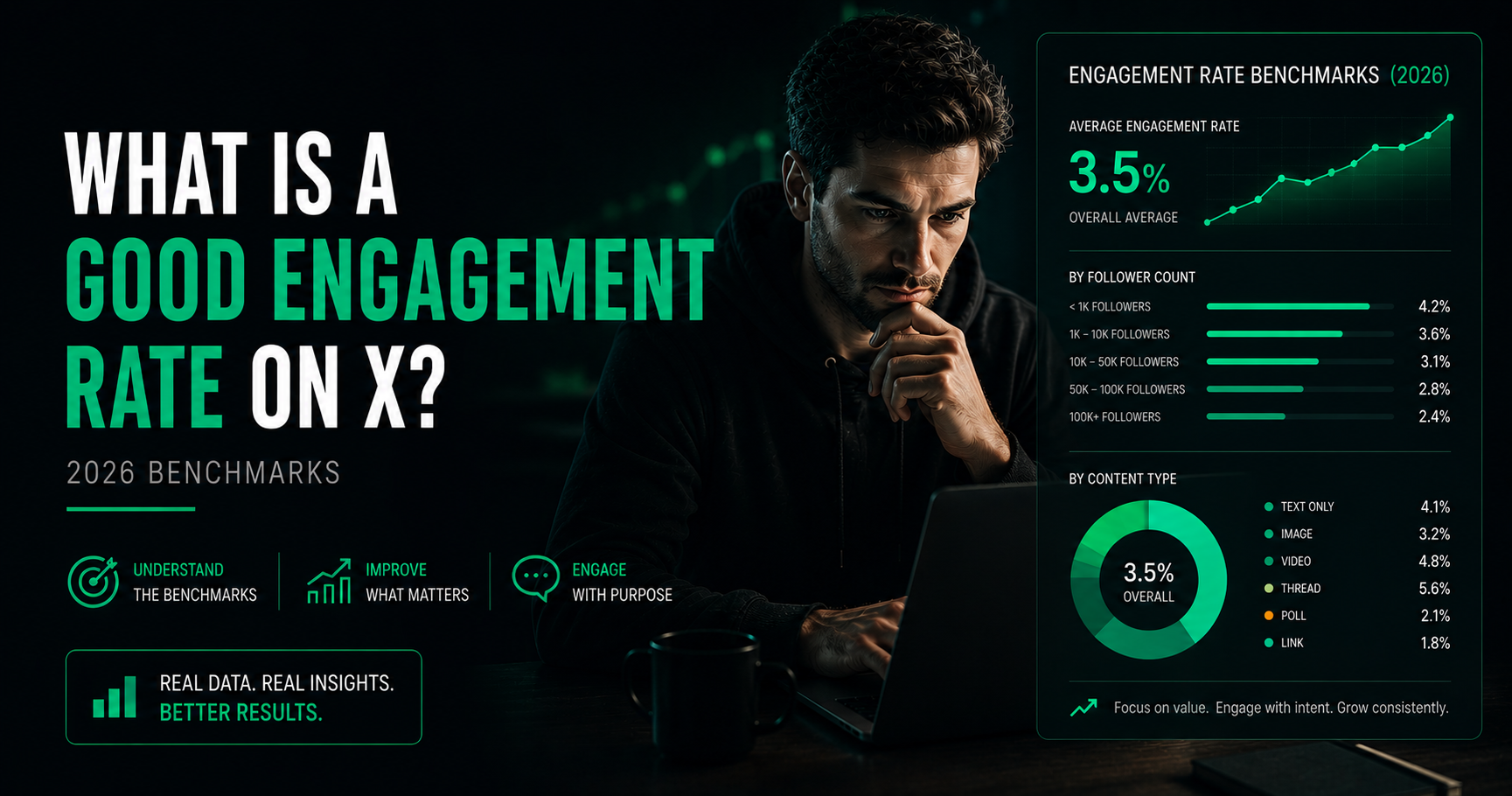
For most accounts in 2026, a good engagement rate on X is 1–3% of impressions. Above 3% is strong. Above 5% means a post massively outperformed its reach. And if you're under 5,000 followers, you should usually be beating these numbers, as small, active accounts regularly hit 3–6%.
These are working benchmarks based on observed account behavior across 2026 analytics data, not platform guarantees, but they're the ranges that separate growing accounts from stuck ones.
That's the short answer. The longer answer is more useful, because most people measuring engagement rate are measuring the wrong thing, comparing against the wrong benchmark, and drawing the wrong conclusion about their account.
Here's what the numbers actually mean in 2026, and what to do if yours are low.
What Counts as Engagement on X?
Engagement on X is any action someone takes on your post: likes, replies, reposts, quotes, bookmarks, link clicks, media clicks, and profile visits from the post. Impressions don't count, that's just how many feeds your post touched. Engagement is what people did about it.
In plain terms: engagement rate is the percentage of people who saw your post and did something about it.
Not all engagements are equal, though. Since the May 2026 algorithm update, analyses of X's Grok-powered ranking system report that replies and conversation chains carry roughly 150x the ranking weight of a like. A post with 10 replies signals more to the algorithm than a post with 500 likes. Keep that in mind when you look at your own numbers: reply-heavy engagement is worth more than like-heavy engagement, even at the same rate.
How Do You Calculate Engagement Rate on X?
The standard formula:
Engagement rate = (total engagements ÷ impressions) × 100
If a post got 5,000 impressions and 120 engagements, that's a 2.4% engagement rate. Solid.
You'll also see engagement rate calculated against followers instead of impressions. Ignore that version. Follower-based rates were useful when feeds were chronological. In 2026's algorithmic feed, your impressions come mostly from non-followers, so measuring against follower count tells you nothing about how your content actually performed with the people who saw it.
To check yours: open any post → View analytics → divide engagements by impressions. For your whole account, X Premium's analytics dashboard shows both numbers over any date range.
What Is a Good Engagement Rate on X in 2026?
Benchmarks by account size:
- Under 5,000 followers: 3–6% (Good: 5%+, Excellent: 8%+)
- 5,000–50,000 followers: 1.5–3% (Good: 3%+, Excellent: 5%+)
- 50,000–200,000 followers: 1–2% (Good: 2%+, Excellent: 4%+)
- 200,000+ followers: 0.5–1.5% (Good: 1.5%+, Excellent: 3%+)
Two context points before you compare yourself:
First, the platform-wide average engagement rate sits around 0.10% in 2026, but that number is dragged down by millions of large, half-dead accounts. It's not your benchmark. A 3,000-follower account at 4% is outperforming a 250,000-follower account at 0.6% in every way the algorithm cares about.
Second, competition for attention is rising. Average impressions per post on X declined roughly 5% year over year (from 2,864 to 2,711, per SociaVault's 2026 data) even as total posts increased. More content, same attention pool. A "good" rate is harder to hit than it was a year ago, which is exactly why it matters more.
What this means for you: find your follower bracket, compare your average rate over the last 20 posts (not your best post), and read the result as a distribution signal. At or above benchmark, the algorithm expands your reach, so keep doing what works. Below it, your next posts get shown to fewer feeds, and the priority is fixing rate before chasing volume.
Why Do Small Accounts Have Higher Engagement Rates?
Small accounts have higher engagement rates because their impressions come almost entirely from high-intent viewers, meaning people who deliberately follow them or found them through a reply or search. Big accounts get pushed to millions of low-intent feeds, where most people scroll past. More reach, weaker average attention.
This is the trap of follower-count thinking. Growing followers while your engagement rate collapses means you're accumulating an audience that doesn't care. The algorithm notices: low engagement rate → less distribution → fewer impressions → the spiral most stuck accounts are in.
If that sounds familiar, your problem usually isn't the writing. It's where and when you're engaging, not the quality of what you say.
Why Does Engagement Rate Matter More Than Followers?
Engagement rate is the main signal X uses to decide whether your next post gets distribution. Followers are a lagging vanity metric; engagement rate is the leading one.
X decides a post's fate in the first 15–30 minutes. Strong early engagement rate → the algorithm expands distribution to more feeds. Weak early rate → the post dies quietly, regardless of how many followers you have. This is also why replies drive more growth than posts for small accounts: a reply inherits the impressions of a post that already proved its engagement rate, instead of gambling on its own.
For monetization, the math is direct. You need 5M impressions in 3 months, and impressions are a function of engagement rate compounding over time, not posting volume.
How Do You Improve Your Engagement Rate on X?
Raise the quality of the conversations you enter, not the volume of content you produce. Concretely:
- Reply more, post less. Replies put you in front of pre-engaged audiences instead of cold feeds. One sharp reply under a rising post beats five posts into the void.
- Pick posts with momentum, not size. A post from a 10K account gaining velocity beats a stale post from a 500K account. Here's how to spot the difference.
- Ask for replies, not likes. End posts with a genuine question. Replies are worth 150x a like to the algorithm, so write for the metric that counts.
- Cut what doesn't perform. Check your last 20 posts. Whatever format sits below your account's average rate, stop making it.
- Predict before you engage. The difference between a 0.5% and a 5% reply is mostly the post you chose to reply to. Tools like ReplyHunter score a post's expected engagement before you spend time writing, so you only invest in conversations likely to pay off: 10 minutes of targeted replies instead of 2 hours of guessing.
Stop guessing which impressions count. Start hunting.
See how ReplyHunter finds the right opportunities for you.
Get Early Access (Free)Frequently Asked Questions
What is the average engagement rate on X?
The platform-wide average engagement rate on X is roughly 0.10% of impressions in 2026, but that figure is misleading as a benchmark. It includes millions of large, inactive, and bot-inflated accounts that drag the average down. For active accounts, realistic averages are much higher: accounts under 5,000 followers typically see 3–6%, mid-sized accounts (5,000–50,000) see 1.5–3%, and large accounts above 200,000 followers settle between 0.5% and 1.5%. When judging your own account, compare against the benchmark for your follower bracket, not the platform average, and track the trend over time, since a falling rate predicts falling impressions before they happen.
Is a 1% engagement rate good on X?
A 1% engagement rate on X is good for a large account and below par for a small one. Above 200,000 followers, 1% is healthy. Under 5,000 followers, it's a warning sign, as small accounts see mostly high-intent viewers and should land far higher. The fix is not posting more, it's engaging where attention already exists.
How do I check my engagement rate on X?
Open any of your posts and tap 'View analytics' to see impressions and total engagements, then divide engagements by impressions and multiply by 100. For account-level tracking, X Premium's analytics dashboard shows aggregate impressions and engagement over any date range. Use impressions as the denominator, not followers, and track your rate weekly: the trend matters more than any single number.
Do replies count toward your engagement rate on X?
Yes, replies count both as engagement you receive and as a growth lever when you give them. 2026 analyses of X's ranking system report that replies and conversation chains carry roughly 150 times the ranking weight of a like. Reply-first strategies consistently outperform post-only strategies for accounts under 10,000 followers, because replies borrow the proven engagement of existing conversations instead of gambling on cold distribution.